Radar System Analysis and Modeling

The measurement performance of a radar system is characterized by the accuracy of its data output under the intended conditions of operation. Accuracy is defined as "freedom from error," and so is characterized by the magnitudes and other properties of the errors in the output data. The preceding sections have discussed the basic processes by which the radar measures the angles, range, and doppler shift of a target, and the effect of thermal noise on those measurements. There are many other sources of radar measurement error that must be considered. In order to discuss these errors in a quantitative fashion, we consider first the methods by which errors are described.
In the discussion of radar targets (Chapter 3), statistical methods were used to describe the amplitude and frequency distributions of radar cross section. The same procedures are applicable to description of errors in radar measurement, which have both systematic and random properties. By choosing mathematical models that are close approximations of the actual error components, we obtain an accurate analysis of the error in a particular system.
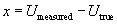
The error x in a given measurement is defined as the difference between the value indicated by the measuring instrument and the true value of the measured quantity:
| (8.71) | |
The purpose of error analysis is to provide a description of the error that will permit its magnitude to be estimated for any set of operating conditions, without the necessity of...