Radar System Analysis and Modeling

A search radar is one "used primarily for the detection of targets in a particular volume of interest. " A surveillance radar is "a search radar used to maintain cognizance of selected traffic within a selected area, such as an airport terminal area or air route" [1]. The implication is that surveillance radar provides for the maintenance of track files on the selected traffic, while the search radar output may be simply a warning or a one-time designation of a target for acquisition by a tracker. This chapter is devoted primarily to the detection of targets within a search radar scan volume, but also summarizes the issues of track file initiation, maintenance, and accuracy.
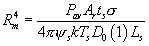
The search radar equation was derived in Chapter 1, relating the noise-limited detection range in a specified solid angle ? s to the power-aperture product of the search radar and other parameters:
| (7.1) | |
where the symbols were defined following (1.23). This equation establishes that the primary radar parameters affecting search performance are the average power and receiving aperture area. The receiving system temperature T s, while important, is often controlled by environmental conditions. Radar parameters such as wavelength and waveform are absent from the equation, although they affect the search loss factor L s. The relationship between the primary radar parameters and performance can be expressed compactly as
| (7.2) | |
where E 0 = kT sD 0(1) L s is...