Radio Receiver Design
This reference focuses on understanding and designing radio receivers and systems, presenting the characteristics of individual receiver components and their interaction in cascade.
 TABLE OF CONTENTS
 Decibels were originally conceived to make measurements of human hearing more understandable. Human hearing covers a 1:10,000,000,000,000 (1:10 13) range from the threshold of hearing to the threshold of pain. This enormous range makes it difficult to plot and analyze data. Decibels make data comparisons easier and graphical data more manageable.
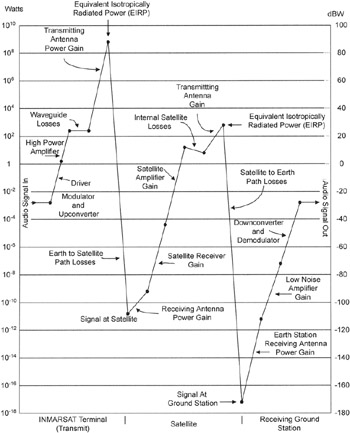
Figure 1-1 shows the range of powers that exist on a typical INMARSAT satellite link. The power levels fall over a 10 26 range. Since Figure 1-1 uses decibels and a logarithmic scale, the data is very readable. Other examples of the large ranges system designers must accommodate include
A typical communications receiver can easily process signals whose input powers vary by a factor of 10 12 or 1 trillion.
On its journey to a geosynchronous satellite a signal can be attenuated by a factor of 10 20.
Filters routinely provide attenuation factors of 10 6 or 1 million.
To make these measurements more manageable, RF engineers have adapted the decibel to their own use. The decibel is one-tenth of a Bel, a logarithmic power ratio named after Alexander Graham Bell. His studies of human hearing showed that the ear responds to sound in a logarithmic rather than a linear fashion. For example, humans perceive a 10 times increase in sound power as a doubling of sound level.
The Bel is defined as
| (1.2) | 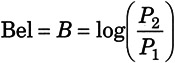 |
The decibel (or dB) is one-tenth of a...