Radio Receiver Design
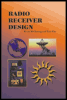
This reference focuses on understanding and designing radio receivers and systems, presenting the characteristics of individual receiver components and their interaction in cascade.
 TABLE OF CONTENTS
 Suppose one of you wants to build a tower. Will he first sit down and estimate the cost to see if he has enough money to complete it? For if he lays the foundation and is not able to finish it, everyone who sees it will ridicule him.
-Luke 14:18-29
This chapter discusses design strategies and considerations for frequency conversion schemes.
It is desirable to build an inexpensive system that includes the cost of mixers, the filter, amplifiers, LOs and their support circuitry, the demodulator, microprocessor and other components. For example, cellular telephones use a first IF of 45 MHz. Every television in the world uses this IF and plenty of cheap components are available that work in that frequency range. Common IFs include 10.7 MHz, 21.4 MHz, 455 kHz, 70 MHz and 160 MHz.
Designing a conversion scheme for a high-performance receiver can be quite involved once you consider all the trade-offs, so there is some validity to designing a receiver using a previously fielded conversion.
Physical size, commercial components, low power and common IFs are usually interdependent.
Small physical size makes it difficult to remove heat. Small systems require that the power supply be very efficient and that the receiver itself require little power. Often battery life has to be considered as well.
Further, the design of the power supply can influence a system in unexpected ways. For example, the switching frequencies present in a switch-mode power supply can appear...