Radio Receiver Design
This reference focuses on understanding and designing radio receivers and systems, presenting the characteristics of individual receiver components and their interaction in cascade.
 TABLE OF CONTENTS
 Decibels enable the designer to calculate signal levels quickly. For example,
A 2-times increase in power.
| (1.40) | 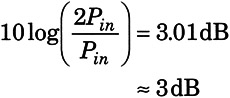 |
A doubling of power is a 3 dB increase.
A 2-times decrease in power.
| (1.41) | 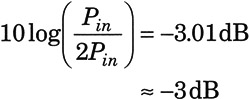 |
Halving the power means a 3 dB decrease.
A 4-times increase in power.
| (1.42) | 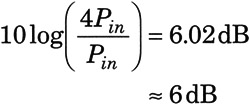 |
A 4-times power increase means doubling the power twice and 3 dB + 3 dB = 6 dB.
A 4-times decrease in power.
| (1.43) | 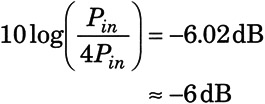 |
A 4-times power decrease means halving the power twice and -3 dB + -3 dB = -6 dB.
A 10-times increase in power.
| (1.44) | 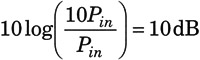 |
Table 1-1 summarizes these results.
| Power Ratio | Decibels |
|---|---|
| 10 -6 | -60 dB |
| 0.001 | -30 dB |
| 0.01 | -20 dB |
| 0.1 | -10 dB |
| 0.5 | -3 dB |
| 1.0 | 0 dB |
| 2 | 3 dB |
| 3 | 4.77 dB |
| 4 | 6 dB |
| 5 | 7 dB |
| 8 | 9 dB |
| 10 | 10 dB |
| 100 | 20 dB |
| 1000 | 30 dB |
| 10 6 | 60 dB |
Table 1-2 indicates that every 10 dB increase in a quantity represents a factor of 10 increase in that quantity. In other words, we gain an order of magnitude for every 10 dB increase. Also note that a decrease of 10 dB represents multiplying the quantity by 1/10, or we lose an order of magnitude.
| Power Level in dBm | Linear Power Level |
|---|---|
| -30 dBm | 0.001 mW = 1 ? W |
| -20 dBm | 0.01 mW = 10 ? W |