The Radioman's Manual of RF Devices, Principles and Practices

Dealing with the RF aspects of radio communication, this is an indispensable book for anyone involved in land mobile radio, ham radio, marine radio or aviation radio.
 TABLE OF CONTENTS
 One of the fundamental principles in radio electronics is that of impedance matching to obtain maximum power transfer from a source to its load. In radio communication systems, impedance matching of the antenna to the transmitter is very important in order to maximize the efficiency of the system. Furthermore, large impedance mismatches can cause very high voltages on the transmission line, shortening the life expectancy and even causing catastrophic failure of transmitting equipment. It can also lead to the generation of spurious signals that can interfere with other users of the radio spectrum. In short, a transmitter is designed to work into a purely resistive 50-ohm load impedance. Every effort should be taken to ensure that the transmitter output sees a 50-ohm impedance.
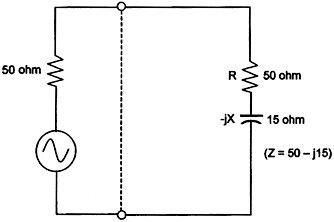
Impedance can be purely resistive or it can consist of a resistive and reactive component. Impedance that consists of a resistive and reactive component is called complex impedance (see Figure 2 1). Here, a 50-ohm generator is terminated in a complex impedance consisting of a 50-ohm resistor and a 15-ohm capacitive reactance. This could represent an improperly matched or mistuned antenna connected to the transmitter. Since the generator s internal impedance is a pure resistance of 50 ohms it must see a purely resistive 50-ohm load before maximum power transfer will occur.