The Radioman's Manual of RF Devices, Principles and Practices

Dealing with the RF aspects of radio communication, this is an indispensable book for anyone involved in land mobile radio, ham radio, marine radio or aviation radio.
 TABLE OF CONTENTS
 The swept-tuned spectrum analyzer is commonly used by RF communication technicians, engineers, and amateurs. This type analyzer is a superheterodyne receiver with special circuits and characteristics (see Figure 3 1). Though this block diagram indicates a single conversion analyzer, typically, a spectrum analyzer would employ triple conversion.
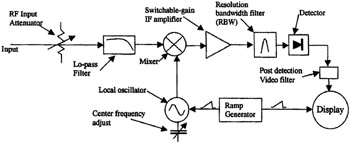
The RF attenuator and the IF amplifier gain are connected. For a given reference level, if the RF attenuation is increased by 10dB the gain of the IF amplifier is increased by 10dB to maintain the reference level. The RF attenuator is used to keep high signal levels from overloading the mixer, thus reducing the level of distortion products at the output of the mixer.
The low-pass filter, located between the RF attenuator and the mixer, removes the image frequencies, thus minimizing undesired responses in the spectrum analyzer. The mixer is where the input signal is beat against the local oscillator (LO) signal to produce the difference or IF frequency. The resolution bandwidth filter (RBW) is centered at the intermediate frequency and can be set for different bandwidths, depending upon the spacing of the signals to be resolved. After the signal is detected, it is passed through a narrow-band video filter to clean up the display.
The LO is a very important part of the spectrum analyzer. The frequency stability and phase noise of the LO becomes a limiting factor in...