The Radioman's Manual of RF Devices, Principles and Practices

Dealing with the RF aspects of radio communication, this is an indispensable book for anyone involved in land mobile radio, ham radio, marine radio or aviation radio.
 TABLE OF CONTENTS
 Site noise can have a tremendous impact on the effectiveness and efficiency of a radio communication system. Site noise generally refers to ambient noise generated at a fixed communication site a big hill or mountain where everyone seems to have a base station installed. This can be extended to include the effects of noise generated and radiated from a vehicle. There, it can affect not only the radio installed in this vehicle, but also radios in vehicles in proximity to the offending vehicle. This chapter discusses some of the problems associated with noise, locating the source and possible remedies.
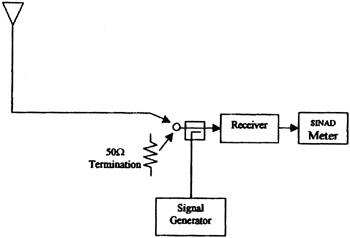
Some receivers require higher signal-to-noise (S/N) ratios than others. For example, a FM receiver of the analog narrow-band type ( 5kHz deviation) typically requires a 4dB S/N to achieve the basic sensitivity of 12dB SINAD. A SSB receiver would require a higher S/N. Figure 7 1 shows a test setup that can be used to determine how much a narrow-band FM receiver s sensitivity is being degraded by on-site noise. In fact, the receiver has the same sensitivity in the on-site situation that it did on the test bench. The fact is that the reception of the desired signal is being degraded by the ambient site noise.