RCM Guidebook: Building a Reliable Plant Maintenance Program
Critical components are the components that matter. They have been called significant, important, essential, or key in various program formulations. This equipment has the direct potential through single failure to compromise system operating goals ( see Fig. 2-2). Single-failure qualification is important; equipment that cannot compromise system functions in single failure drops to a lower status. Equipment requiring failure chains to fail in their functions become non-critical and are addressed by a program of no scheduled maintenance (e.g., run-to-failure). This equipment can be safely and cost-effectively maintained upon discovery of failure symptoms.
Run-to-failure equipment makes up a large inventory of the equipment in any complex industrial facility and supports a strategy of no scheduled maintenance. Plants can use run-to-failure equipment to their advantage building a maintenance strategy. Taking advantage of inherent design characteristics reduces maintenance costs and improves reliability. This is the essence of RCM).
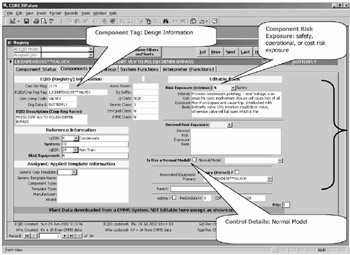
Single-failure criteria lead to concise, critical equipment lists. Excluding non-critical equipment from analytical scheduled maintenance consideration focuses effort on the remaining critical equipment. Critical equipment, then, is assigned a risk exposure classification safety, operations, or cost (SOC). These categories create a system risk profile (e.g., an equipment risk exposure list). This profile ranks relative value, differentiating equipment that benefits from scheduled maintenance from that which does not. Developing this profile is valuable in its own right for evaluating failed equipment during plant...