RCM Guidebook: Building a Reliable Plant Maintenance Program

Large groups perform and develop facility work. Work groups need data management controls. From a practical viewpoint, data controls such as spreadsheet documents are difficult to manage in shared-responsibility work groups. Scheduled maintenance plan development involves four primary work groups:
risk engineers
maintenance engineers/systems engineers
craft (electricians, technicians, mechanics)
scheduler advisor planners
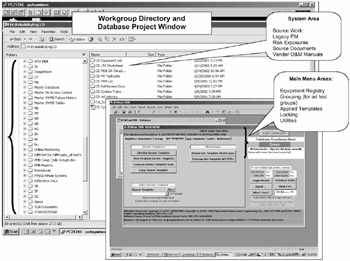
Scheduled maintenance development projects (PM reconstitution, PMO, or RCM) are more difficult to manage as projects than their product's daily use and revision. Large files, with many people reviewing and updating similar records concurrently introduce more chances for data conflict. Daily maintenance use, on the other hand, challenges the commitment to maintain and update records and files, obtain approvals, and follow a prepared process and plan ( see Fig. 9-1).
Many project processes wither and die after participants move on. Once a project passes into daily PM use, the real test of simplicity, friendliness, and intrinsic value (important in the eyes of the process owners) becomes evident. Processes that need more care and feeding than their output delivers are not worth the effort.
No process is perfect; no software is perfect. Spreadsheets and documents are even less perfect, but open formats mask their imperfection. Large work group control in a document or spreadsheet environment is fraught with consistency conflict and errors. Networked applications offer flexibility, capitalizing on database use of some kind that can realize network potential. That concluded, users and database developmental requirements drive application selection. Document...