RCM Guidebook: Building a Reliable Plant Maintenance Program
Large maintenance programs require force multipliers to systematically develop consistent maintenance plans. Equipment templates provide one such force multiplier. Scheduled maintenance component template strategy is recognized by standards such as INPO AP-913 Equipment Reliability Process Description to assure maintenance consistency and effectiveness while developing consistent, cost-effective maintenance plans. Templates trade installed equipment variability and complexity for a predeveloped solution. Template application must appropriately consider these limitations.
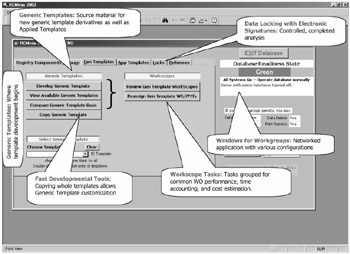
Spreadsheet component templates have been used in RCM-based PM development for nearly 20 years. These two-dimensional flat files cannot develop multidimensional relational tables simply. Tables capture rich normalized data relationships in a database. Relational tables more easily portray the RCM depth needed to model different aging, risk, design, and performance factors. Relationships can interface to CMMS/EAMS' relational scheduled maintenance tables to automatically load PM program plans. These database middleware speed the final uploading steps into the CMMS ( see Fig. 3-1).
Template means pattern. Templates model component maintenance plans. They provide common, prepared source patterns. Template utility stems from common design and widespread use potential. A vehicle maintenance template could apply to most highway vehicles. Common vehicles with oil sumps, windshields, and tires could be covered. Once a new vehicle variant had been discovered, a new template would be sought. Using a template effectively requires understanding template application limits. As new equipment extensions are found, the template should be extended to cover them.
Templates summarize similar equipment maintenance programs. Template success depends on...