RCM Guidebook: Building a Reliable Plant Maintenance Program
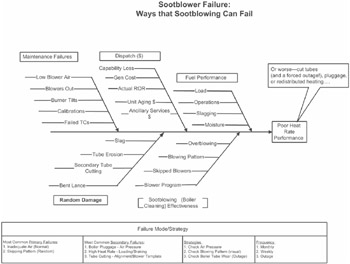
Failures occur in many ways and in many contexts. Failures start as bottom-initiating events, some of which propagate upward causing system failures. Reliability maintenance strategies do not limit failures outright, for some are inevitable, based upon randomly failing subcomponents in designs. Rather, the goal is to manage failures within limitations and intent of design ( see Fig. 5-1).
For most maintenance participants, acknowledging what they all privately appreciate that failures are not all created equal, or necessarily all bad comes hard. As operators know, some failures are worse than others.
Risk analysis is RCM's first feature, one to which maintenance people have less access compared with operating staffs. At a high level, operators have a working understanding of failure based on risk while maintenance workers understand and interpret equipment failure at the equipment level. Even here, mechanics (unlike operators) don't keenly grasp equipment operating risk. Risk depends on design installation redundancy, probability of failure, and consequence that compromises function of equipment in the operating interest period.
Equipment carries performance expectation. Falling short of expected performance constitutes failure. Understanding failures in an engineering world requires specifying performance expectations appropriately with performance limits. Performance limits can be expressed formally at the systems level with quantified outputs. Industrial facilities produce tangible goods and services. The inability to produce at specified quantities and quality levels defines failure ( see Fig. 5-2)
Systems incorporate adequate...