Reliability & Life Testing Handbook, Volume 2

Binomial or Bernoulli trials are those in which (1) each trial results in either a success or a failure, (2) the probability of success does not change from trial to trial, and (3) the outcome of one trial does not affect the outcome of any other trial. Trials that can result only in complete success or complete failure are known as Bernoulli trials.
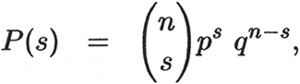
The binomial probability density function is
| (1.1) | |
or
| (1.2) | |
where, in reliability engineering,
n = number of Bernoulli trials,
s = number of successes, and s ? n,
p = R = probability of success in each trial, or the reliability of each trial,
and
q = 1 - p = 1 - R = Q = probability of failure in each trial, or the unreliability of each trial.
Equation (1.2) then gives the probability of exactly s successes out of n Bernoulli trials where the probability of success in each trial is R.
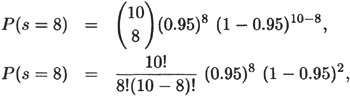
| Q: | The probability of a unit successfully completing a mission is 0.95. What is the probability of exactly 8 out of 10 units completing their mission successfully? |
|
Answers
| Q: | For p = R = 0.95 and s = 8, Eq. (1.2) becomes or P( s = 8) = 0.0746. The value of P( s) may also be obtained from tables such as Table 1.1, where the values of the individual... |