Reliability & Life Testing Handbook, Volume 2

This section introduces Bayes' Theorem from several points of view and presents numerical examples to highlight a number of important concepts. Comparisons with classical statistical methodologies are also made.
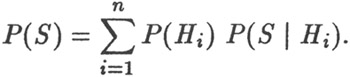
Let H 1, H 2, , H n represent a mutually exclusive and exhaustive collection of hypotheses. Suppose that an event S exists and the conditional probabilities P( SH i) are known. Also, suppose that the probabilities P( H i) are known. Then, for the discrete case, the following conditional relationship is known as Bayes' Theorem:
| (11.1) | |
where
P( H i) is termed the prior probability that H i is true and P( H i S) is the posterior probability that H i is true upon observing a sample statistic S.
In the continuous case, Bayes' Theorem may be expressed as
| (11.2) | |
where g( ?) is the prior probability density function with ? as the random variable. P( ? S) is the posterior probability density function with ? as the random variable and h( S ?) is the conditional distribution of S.
Equation (11.2) permits probabilistic statements regarding ? upon observing the statistic S. Thus, observed data is combined with the prior density via the conditional distribution to form the posterior density.
From a less formal point of view, the discrete case of Bayes'...