Resource Allocation in Hierarchical Cellular Systems
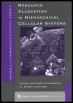
A highly-detailed and highly technical examination of cellular channel
allocation strategies.
 TABLE OF CONTENTS
 DCA overcomes the main drawback of FCA strategies no or little adaptability to temporal and spatial variations of traffic by assigning channels in a dynamic way. In contrast to FCA, in DCA strategies there is no relationship between the channels and the cells and every channel can be used in any cell as long as the cochannel reuse distance and the interference constraints are fulfilled [27 61]. The channels are used in the cells only for the duration of the call [3]. Arrivals are attended on a call-by-call basis, searching for the channel with minimum cost to the system. Normally, in this strategy there exists a central pool in charge of assigning channels to each cell according to a cost function that maximizes channel efficiency (whenever possible). As soon as the calls are over, the channels are returned to the central pool. The main idea of all DCA strategies is to evaluate the use of a candidate channel by means of the cost function and to select those with minimum cost to the system. Different DCA schemes are distinguished by the type of the cost function [22]. This can be a function of the future expected load [23], the future overall or average blocking in the system [24], the usage frequency of the candidate cell, the reuse distance, channel occupancy distribution under current traffic conditions, or radio channel measurements of individual mobile users [25]. In practice, DCA strategies are divided into three main groups that exploit one of the following characteristics...