Resource Allocation in Hierarchical Cellular Systems

A highly-detailed and highly technical examination of cellular channel
allocation strategies.
 TABLE OF CONTENTS
 Once the blocking probability has been calculated for every type of service in the microcell layer, we proceed to calculate the mean and the variance of the overflow traffic by introducing a fictitious, infinite server overflow group as in [1] and as in Section 5.2.1, with the number of channels M sufficiently large compared with the load submitted to a microcell.
This system could be described by a state ( j 1, j 2, , j x, N 1, N 2 N x) with equilibrium state probability Q( j 1, j 2, , j x, N 1, N 2, , N 2 in which j 1 to j x were defined earlier and N i is the number of calls of type i present in the overflow group. Note that the calls served in a microcell have mobility, but the calls served by the fictitious group are stationary. This system is described in Figure A.1. The state equations are formulated next.
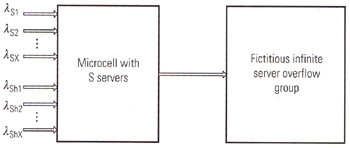
For the case when 0 k 1 < S and O Y < M, where
| (A.1) |  |
| (A.2) |  |
| (A.3) | 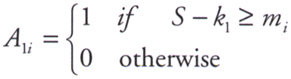 |
| (A.4) | 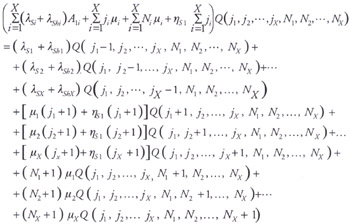 |
The equilibrium equations for the boundary state k 1= S and 0 Y M are given next. For this purpose, let us define
| (A.5) | 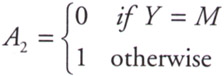 |