Resource Allocation in Hierarchical Cellular Systems
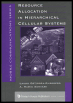
A highly-detailed and highly technical examination of cellular channel
allocation strategies.
 TABLE OF CONTENTS
 In this chapter a capacity assessment is presented for UMTS by means of system level simulations of the downlink (DL) of two systems to be used in it: hybrid WB-TD/CDMA using asymmetric TDD and WB-CDMA using FDD.
These systems have been deliberately chosen because they correspond, respectively, to the future radio wideband multiple access system (FRAMES) project proposal mode I and mode 2 for UMTS Terrestrial Radio Access (UTRA). The cell capacity in ErI/carrier/cell and the spectrum efficiency in Kbps/MHz/cell are assessed for five different circuit switched services in a 5-MHz bandwidth in a microcellular environment with nonuniform traffic. Two different resource allocation strategies are considered in the evaluation of the TD/CDMA-TDD system: the classic FCA and the simple dynamic channel allocation (SDCA) strategies. For WB-CDMA, only FCA is used. Blocking and forced termination probabilities are presented and compared for the TD/CDMA-TDD system using FCA and SDCA.
The European research program ACTS (Advanced Communications Technologies and Services) started in the end of 1995 to support collaborative mobile research and development. Within the framework of the ACTS program, the project FRAMES was in charge of defining a multiple access scheme for third generation UMTS.
Within FRAMES, an extensive evaluation study was carried our to investigate different multiple access technologies [1] Two proposals were made:
The evaluation led to the FRAMES multiple access (FMA) concept, which contains only two modes