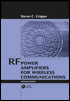
RF Power Amplifiers for Wireless Communications, Second Edition
Chapter 4: Class AB PAs at GHz Frequencies

4.1 Introduction

The classical PA design theory described in the last chapter is based on a number of idealizing assumptions, both in the active and passive element models employed. Although the nature of these idealizations was clearly defined, it is a curious fact that expectations of a practical PA design or product are still widely based on the classical results, regardless of deleterious effects that must come into play at GHz frequencies. Such effects as parasitic capacitance, especially on the input of RF power transistors, and the turn-on characteristic of the I-V device response will surely modify the classical results in a substantial manner. Yet there has been an endemic culture, especially pervasive in the PA customer and user community, which has nurtured a blind spot for such matters of detail. If it s a Class B amplifier, the expectation for efficiency is 78.5%, right on the button, or something is wrong with the design. So in this chapter we have rather more at stake than merely digging deeper and working out the more detailed aspects of PA design in the real world.

The problem is complicated by the fact that Class B PAs can sometimes deliver 78% efficiency, and even a bit more, if various performance compromises are made with power and linearity. But the manner in which this is achieved seems to have rarely been seen in print, largely due to the difficulty for the GHz designer to observe current and voltage waveforms, along with the widespread use...

UNLIMITED FREE
ACCESS
TO THE WORLD'S BEST IDEAS

SUBMIT
Already a GlobalSpec user? Log in.

This is embarrasing...

An error occurred while processing the form. Please try again in a few minutes.

Customize Your GlobalSpec Experience

Category: Chip Antennas
Finish!
Privacy Policy

This is embarrasing...

An error occurred while processing the form. Please try again in a few minutes.