RF Power Amplifiers for Wireless Communications, Second Edition
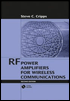
The oscillatory habits of RF power transistors are an infamous aspect of RF power amplifier design. This much-dreaded skeleton jumps out of its closet at the most inconvenient times, frequently causing destruction and panic in its wake. Its effects are most prevalent at lower frequencies in the MHz to VHF range, where the terminating impedances of an RF power device are mainly defined by the bias insertion networks. The design of bias networks for any RF power amplifier therefore plays an important part in establishing stable operation.
The subject has a curious history, which takes us into the murky waters of cultural divides not just the different world-views of low frequency analog and microwave designers, but also the overlapping roles of circuit designer and lab technician. While the RF designer uses an array of advanced analytical tools and techniques to design an RF matching circuit for a 2 GHz power amplifier, an oscillation at 60 MHz is passed off as a minor irritation (smoke notwithstanding) that can be removed using a shotgun-style artillery of capacitors and ferrite beads. The plot (not necessarily the smoke) then thickens; having established a combination of randomly soldered components that seem to stabilize a particular device, the same pot pourri becomes enshrined as a standard for others to duplicate. Data sheets, application notes, demonstration test boards, all start to recommend or use a bias network configuration which is largely based on empirical design methods, without any real appreciation of what the problem was...