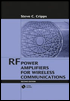
RF Power Amplifiers for Wireless Communications, Second Edition
9.9: Conclusions

9.9 Conclusions

As stated in the introduction to this chapter, treating the subject of PA nonlinearity is a challenge which usually delivers less than it might promise. Typical scenarios can be analyzed to death, but the bottom line is much the same as that which can be deduced using the simplest of heuristic arguments: any signal whose peak envelope power exceeds the power level at which gain compression or AM-PM occurs will cause distortion, which in the frequency domain will appear as intermodulation or spectral regrowth. If the mean power level of the signal is backed off to the point where about 1 dB compression occurs at the peak envelope power, the spectral regrowth will drop to a level which is frequently acceptable for single channel applications, but probably unacceptable for multichannel applications. In the latter case, external linearization will enable a compromise in the amount of additional power backoff required in order to satisfy the regulatory spectral requirements.

This basic backoff guideline can be used for setting mean power levels with different peak-to-average ratio signals. In a case such as a CDMA uplink having 5 dB PAR, this would mean operating the PA at a mean power level 5 dB below the 1 dB compression point; a 3 watt transistor would be needed to deliver 1 watt of CDMA power, at an efficiency down by a factor of 3 on the efficiency measured in a cw test at the 1 dB compression point; this may typically be well below...

UNLIMITED FREE
ACCESS
TO THE WORLD'S BEST IDEAS

SUBMIT
Already a GlobalSpec user? Log in.

This is embarrasing...

An error occurred while processing the form. Please try again in a few minutes.

Customize Your GlobalSpec Experience

Category: RF Power Detectors
Finish!
Privacy Policy

This is embarrasing...

An error occurred while processing the form. Please try again in a few minutes.