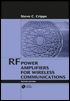
RF Power Amplifiers for Wireless Communications, Second Edition
As already stated in the introduction to this chapter, this section is not a treatise on digital modulation. This subject has been well covered elsewhere and is the subject of many dedicated books (see bibliography). The goal here is to draw attention to the key issues which affect the design and operation of typical PA designs using a few standard modulation schemes encountered in wireless communications systems. The most important of these are the GSM (GMSK) system used throughout Europe, the 2.5G EDGE derivative which is finding more widespread use than the GSM replacement for which it was originated, and the various generations of CDMA implementation, including the 3GPP WCDMA system. Orthogonal Frequency Division Multiplex, or OFDM, is a more recent addition and is now standardized in various 802.11 and 802.16 variants aimed at Wireless Local Area Networks (WLAN) and high speed data access (WiFi, WiMax). Unfortunately, the standards associated with all of these systems are frequently updated, and whole new systems are being created at a bewildering pace.
When making the step from analog to digital modulation, it is usually necessary to make a conceptual step from mathematical functionality and analytical certainty to random sequences and statistical probabilities. In principle, it is still possible to employ the same envelope approach to estimate the distortion levels in RF power amplifiers as was used earlier in this chapter to analyze simpler modulation formats. The key word, however, is estimate. This can...