9.2 Two-Carrier Power Series Analysis
As already commented in the introduction, two-carrier analysis, based on a power or Volterra series, represents the traditional approach to analyzing nonlinear effects in RF amplifiers. As a first step, it is necessary to review, or revisit the technique. It is assumed that most readers will have encountered it in some form already, and some of the more detailed trigonometric manipulation has been omitted. A relevant set of trigonometric formulae are given in Table 9.1 to assist in following the analysis in this and subsequent sections.
Table 9.1: Trigonometric Relationships | 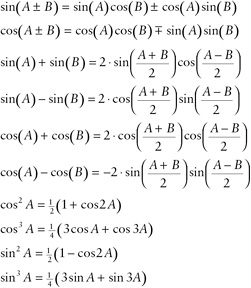 |
We assume a weakly nonlinear amplifier, whose output and input voltage can be related using the standard power series formulation discussed in Chapter 1:
where v i, v o are small, time varying quantities representing the RF input and output signals. For the time being, the a n coefficients are taken to be scalar quantities which characterize the amplifier and are determined experimentally. Generally speaking, one set of coefficients will only apply for a single frequency and a fixed set of biasing and tuning conditions.
We now substitute for an input signal consisting of two, equal amplitude, in-band RFC signals, whose spacing is much smaller than either RF frequency.
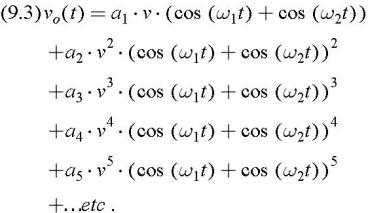
So the output voltage is
Each line, above, of (9.3), represents a degree of signal distortion. Each degree of distortion generates a number of distortion products, which have either the same or lower orders. For example, the second degree term produces second order...

 TABLE OF CONTENTS