RF Power Amplifiers for Wireless Communications, Second Edition
The analysis presented in Section 9.2 clearly has limitations, mainly due to the exclusion of higher degree terms in the power series, which become important as the compression point is reached. The analysis so far has essentially been done entirely in the frequency domain. It therefore pays to look at the same problem in the time domain to get a more direct intuitive feel for what happens to an amplifier when driven with a variable envelope signal. Starting once again with the two-carrier signal,
this can be rearranged, using Table 9.1 again as trigonometric guidance, in the form
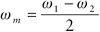
If we now define
;
, (9.11) can be written as
This is now recognizable as a double sideband, suppressed carrier, amplitude modulated signal, having a carrier frequency of ? and a sinusoidal baseband modulating signal of frequency ? m. In order to generate such a radio signal it is necessary for the modulating signal cos ? m t to reverse the phase of the RF carrier by 180 at each zero crossing, that is to say the modulation is case-sensitive to the sign of the modulating function, cos ? m t. This phase reversal is not really visible when the resulting envelope of the signal is drawn as in Figure 9.5. Drawing envelopes of this kind presents a challenge to the printer; inasmuch as it is not possible to resolve the individual RF cycles, the phase variations cannot be indicated either. It is...