Safety Instrumented Systems Verification: Practical Probabilistic Calculations

Probability is a quantitative method of expressing chances. A probability is assigned a number between zero and one, inclusive. A probability assignment of zero means that the event is never expected. A probability assignment of one means that the event is always expected.
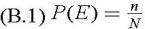
Probabilities are often assigned based on historical "frequency of occurrence." An experiment is repeated many times, say N. A quantity is tabulated for each possible outcome of the experiment. For any particular outcome, the probability is determined by dividing the number of occurrences, n, by the number of trials.
The values become more certain as the number of trials is increased. A definition of probability based on this concept is stated in Equation B-2:
A convenient way to depict the outcomes of an experiment is through the use of the Venn diagram. These diagrams were created by John Venn (1834 1923), an English mathematician and cleric. They provide visual representation of data sets, including experimental outcomes. The diagrams are drawn by using the area of a rectangle to represent all possible outcomes; this area is known as the "sample space." Any particular outcome is shown by using a portion of the area within the rectangle.
For the toss of a fair pair of dice, the possible outcomes are shown in the Venn diagram of Figure B-1. The outcomes do not occupy the same area on the diagram. The probabilities of some outcomes are more likely than others; these occupy more area. For example, the...