Safety Instrumented Systems Verification: Practical Probabilistic Calculations

Modeling the repair process can be complex and error prone. Fortunately, several assumptions can be made which simplify the analysis without serious impact on the results. However, one must understand the limits of these assumptions and simplifications.
In many ways modeling the repair process is difficult because the repair process is quite different from the failure process. Random failures are due to a stochastic process and most of our modeling techniques were created for these stochastic processes. Certain aspects of the repair process are deterministic. Other aspects of the repair process are stochastic. Fortunately, we can approximate the repair process more accurately with Markov models than most other techniques.
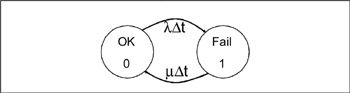
An estimate of repair probability can be made. Consider the single component Markov model of Figure G-1. Assume that failures are immediately detected when they occur. One can accurately model the repair process with a discrete time Markov model. Using a delta t of one hour, one must estimate the probability of repair for each hour after reaching state 1.
Assume that it is estimated that the repair probability will vary with time (non-homogeneous). Table G-1 shows a set of example repair time statistics. These statistics indicate that the repair time of a set of 64 repairs varied from one to six hours. Six units were repaired within one hour. Sixteen units were repaired within two hours. Other units took longer. Based on these numbers the average repair time is approximately...