Safety Instrumented Systems Verification: Practical Probabilistic Calculations

Appendix D: Markov Models

Introduction

A set of modeling tools based around Markov models can be effectively used to solve a wide variety of reliability and safety problems. Markov models work well as these are stochastic processes, processes where outcomes cannot be accurately predicted but probabilities of outcomes can be obtained.

A Markov system is defined as a "memory-less" system where the probability of moving from one state to another is dependent only upon the current state and not past history of getting to the state. This is the primary characteristic of a Markov model. Markov models are well suited to problems where a state naturally indicates the situation of interest. In some models (characteristic of reliability and safety models) a variable follows a sequence of states. These problems are called Markov chains.

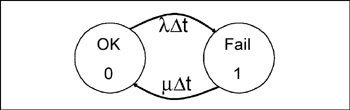
Markov models can deal with a number of complex issues found in the probabilistic modeling of reliability and safety. The models can show system success versus system failure (Figure D-1).


Figure D-1: Two State Model - Success and Failure

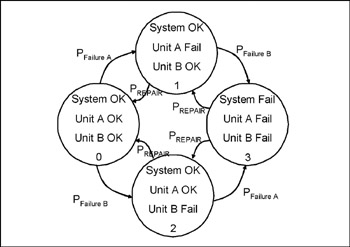
Markov models can show redundancy with different levels of redundant components. Figure D-2 shows a system with two subsystems where only one is required for successful system operation. All failures are immediately recognized and the repair probability is modeled as a constant.


Figure D-2: Redundant Dual System

If both units in a dual redundant system are identical (or close enough so that we do not care which one fails), a model like the one shown in Figure D-2 can be simplified to...

UNLIMITED FREE
ACCESS
TO THE WORLD'S BEST IDEAS

SUBMIT
Already a GlobalSpec user? Log in.

This is embarrasing...

An error occurred while processing the form. Please try again in a few minutes.

Customize Your GlobalSpec Experience

Category: Reliability Software
Finish!
Privacy Policy

This is embarrasing...

An error occurred while processing the form. Please try again in a few minutes.