Satellite Communications, Fourth Edition
Satellites (spacecraft) orbiting the earth follow the same laws that govern the motion of the planets around the sun. From early times much has been learned about planetary motion through careful observations. Johannes Kepler (1571 1630) was able to derive empirically three laws describing planetary motion. Later, in 1665, Sir Isaac Newton (1642 1727) derived Kepler s laws from his own laws of mechanics and developed the theory of gravitation [for very readable accounts of much of the work of these two great men, see Arons (1965) and Bate et al. (1971)].
Kepler s laws apply quite generally to any two bodies in space which interact through gravitation. The more massive of the two bodies is referred to as the primary, the other, the secondary or satellite.
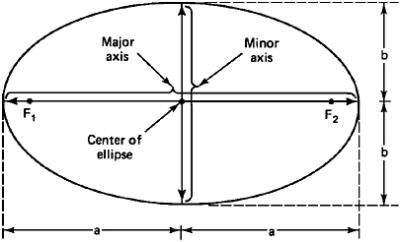
Kepler s first law states that the path followed by a satellite around the primary will be an ellipse. An ellipse has two focal points shown as F 1 and F 2 in Fig. 2.1. The center of mass of the two-body system, termed the barycenter, is always centered on one of the foci. In our specific case, because of the enormous difference between the masses of the earth and the satellite, the center of mass coincides with the center of the earth, which is therefore always at one of the foci.