Satellite Communications, Fourth Edition
14.5: Spade System

14.5 Spade System

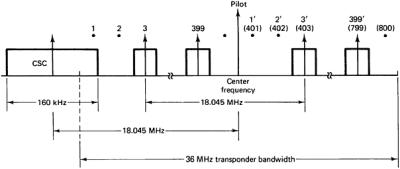
The word Spade is a loose acronym for SCPC pulse-code-modulated multiple-access demand-assignment equipment. Spade was developed by Comsat for use on the INTELSAT satellites (see, e.g., Martin, 1978) and is compatible with the INTELSAT SCPC preassigned system described in Sec. 14.3. However, the distributed-demand assignment facility requires a common signaling channel (CSC). This is shown in Fig. 14.8. The CSC bandwidth is 160 kHz, and its center frequency is 18.045 MHz below the pilot frequency, as shown in Fig. 14.8. To avoid interference with the CSC, voice channels 1 and 2 are left vacant, and to maintain duplex matching, the corresponding channels 1 ? and 2 ? are also left vacant. Recalling from Fig. 14.5 that channel 400 also must be left vacant, this requires that channel 800 be left vacant for duplex matching. Thus six channels are removed from the total of 800, leaving a total of 794 one-way or 397 full-duplex voice circuits, the frequencies in any pair being separated by 18.045 MHz, as shown in Fig. 14.8. (An alternative arrangement is shown in Freeman, 1981.)


Figure 14.8: Channeling scheme for the Spade system.

All the earth stations are permanently connected through the CSC. This is shown diagrammatically in Fig. 14.9 for six earth stations A, B, C, D, E, and F. Each earth station has the facility for generating any one of the 794 carrier frequencies using frequency synthesizers. Furthermore, each earth station has a memory...

UNLIMITED FREE
ACCESS
TO THE WORLD'S BEST IDEAS

SUBMIT
Already a GlobalSpec user? Log in.

This is embarrasing...

An error occurred while processing the form. Please try again in a few minutes.

Customize Your GlobalSpec Experience

Category: Telephones and Cellular Phones
Finish!
Privacy Policy

This is embarrasing...

An error occurred while processing the form. Please try again in a few minutes.