Satellite Communications, Fourth Edition

Chapter 3: The Geostationary Orbit

3.1 Introduction

A satellite in a geostationary orbit appears to be stationary with respect to the earth, hence the name geostationary. Three conditions are required for an orbit to be geostationary:

  1. The satellite must travel eastward at the same rotational speed as the earth.

  2. The orbit must be circular.

  3. The inclination of the orbit must be zero.

The first condition is obvious. If the satellite is to appear stationary, it must rotate at the same speed as the earth, which is constant. The second condition follows from this and from Kepler s second law (Sec. 2.3). Constant speed means that equal areas must be swept out in equal times, and this can only occur with a circular orbit (see Fig. 2.2). The third condition, that the inclination must be zero, follows from the fact that any inclination would have the satellite moving north and south, (see Sec. 2.5 and Fig. 2.3), and hence it would not be geostationary. Movement north and south can be avoided only with zero inclination, which means that the orbit lies in the earth s equatorial plane.

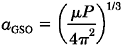
Kepler s third law may be used to find the radius of the orbit (for a circular orbit, the semimajor axis is equal to the radius). Denoting the radius by a GSO , then from Eqs. (2.2) and (2.4),

(3.1)

The period P for the geostationary is 23 h, 56 min, 4 s mean solar time (ordinary clock time). This is the time taken for the...

UNLIMITED FREE
ACCESS
TO THE WORLD'S BEST IDEAS

SUBMIT
Already a GlobalSpec user? Log in.

This is embarrasing...

An error occurred while processing the form. Please try again in a few minutes.

Customize Your GlobalSpec Experience

Category: Satellites
Finish!
Privacy Policy

This is embarrasing...

An error occurred while processing the form. Please try again in a few minutes.