Satellite Communications, Fourth Edition

Chapter 5: Polarization

5.1 Introduction

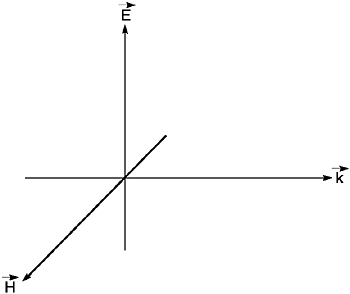
In the far field zone of a transmitting antenna, the radiated wave takes on the characteristics of a transverse electromagnetic (TEM) wave. Far field zone refers to distances greater than 2 D 2/ ? from the antenna, where D is the largest linear dimension of the antenna and ? is the wavelength. For a parabolic antenna of 3 m diameter transmitting a 6-GHz wave ( ? = 5 cm), the far field zone begins at approximately 360 m. The TEM designation is illustrated in Fig. 5.1, where it can be seen that both the magnetic field H and the electric field E are transverse to the direction of propagation, denoted by the propagation vector k.


Figure 5.1: Vector diagram for a transverse electromagnetic (TEM) wave.

E, H, and k represent vector quantities, and it is important to note their relative directions. When one looks along the direction of propagation, the rotation from E to H is in the direction of rotation of a right-hand-threaded screw, and the vectors are said to form a right-hand set. The wave always retains the directional properties of the right-hand set, even when reflected, for example. One way of remembering how the right-hand set appears is to note that the letter E comes before H in the alphabet and rotation is from E to H when looking along the direction of propagation.

At great...

UNLIMITED FREE
ACCESS
TO THE WORLD'S BEST IDEAS

SUBMIT
Already a GlobalSpec user? Log in.

This is embarrasing...

An error occurred while processing the form. Please try again in a few minutes.

Customize Your GlobalSpec Experience

Category: Antennas
Finish!
Privacy Policy

This is embarrasing...

An error occurred while processing the form. Please try again in a few minutes.