Satellite Communications, Fourth Edition
Chapter 12: The Space Link

12.1 Introduction

This chapter describes how the link-power budget calculations are made. These calculations basically relate two quantities, the transmit power and the receive power, and show in detail how the difference between these two powers is accounted for.

Link-budget calculations are usually made using decibel or decilog quantities. These are explained in App. G. In this text [square] brackets are used to denote decibel quantities using the basic power definition. Where no ambiguity arises regarding the units, the abbreviation dB is used. For example, Boltzmann's constant is given as ?228.6 dB, although, strictly speaking, this should be given as ?228.6 decilogs relative to 1 J/K. Where it is desirable to show the reference unit, this is indicated in the abbreviation, for example, dBHz means decibels relative to 1 Hz.

12.2 Equivalent Isotropic Radiated Power

A key parameter in link-budget calculations is the equivalent isotropic radiated power, conventionally denoted as EIRP. From Eqs. (6.4) and (6.5), the maximum power flux density at some distance r from a transmitting antenna of gain G is

(12.1)

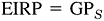
An isotropic radiator with an input power equal to GP S would produce the same flux density. Hence, this product is referred to as the EIRP, or

(12.2)

EIRP is often expressed in decibels relative to 1 W, or dBW. Let P S be in watts; then

(12.3)

where [ P S] is also in dBW and [ G] is in dB.

Example 12.1 A satellite...

UNLIMITED FREE
ACCESS
TO THE WORLD'S BEST IDEAS

SUBMIT
Already a GlobalSpec user? Log in.

This is embarrasing...

An error occurred while processing the form. Please try again in a few minutes.

Customize Your GlobalSpec Experience

Category: Audible Alarms
Finish!
Privacy Policy

This is embarrasing...

An error occurred while processing the form. Please try again in a few minutes.