Schaum's Outline of Theory and Problems of Analog and Digital Communications, Second Edition

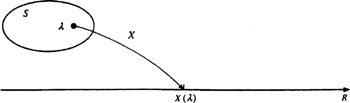
Consider a random experiment with sample space S. A random variable X( ?) is a single-valued real function that assigns a real number called the value of X( ?) to each sample point ?, of S. Often we use a single letter X for this function in place of X( ?) and use r.v. to denote the random variable. A schematic diagram representing a r.v. is given in Fig. 6-1.
The sample space S is termed the domain of the r.v. X, and the collection of all numbers [values of X( ?)] is termed the range of the r.v. X. Thus, the range of X is a certain subset of the set of all real numbers and it is usually denoted by R X. Note that two or more different sample points might give the same value of X( ?), but two different numbers in the range cannot be assigned to the same sample point.
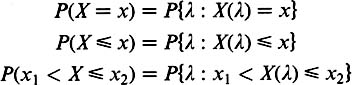
The r.v. X induces a probability measure on the real line as follows:
If X can take on only a countable number of distinct values, then X is called a discrete random variable. If X can assume any values within one or more intervals on the real line, then X is called...