Schaum's Outline of Theory and Problems of Analog and Digital Communications, Second Edition

Chapter 9: Optimum Detection

9.1 INTRODUCTION

In this chapter we study the performance of digital communication systems in the presence of additive noise as measured by the probability of error and introduce the concept of the optimum signal detection. We assume throughout a distortionless channel, so the received signal is free of intersymbol interference (ISI). We also assume additive white gaussian noise (AWGN) with zero mean value, independent of the signal.

9.2 BINARY SIGNAL DETECTION AND HYPOTHESIS TESTING

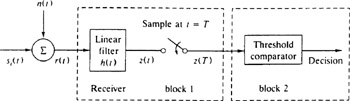
Figure 9-1 portrays the operations of a binary receiver. The transmitted signal over a symbol interval(O, T) is represented by


The received signal r( t) by the receiver is represented by


where n( t) is a zero-mean AWGN.

There are two separate steps involved in signal detection. The first step consists of reducing the receive signal r( t) to a single number z( T). This operation can be performed by a linear filter followed by a sampler, as shown in block 1 of Fig. 9-1. The output of receiver (block 1), sampled at t = T, yields


Figure 9-1: Digital signal detection

where a i( T) is the signal component of z( T) and n o( T) is the noise component. We often write Eq.( 9.3a) as


Note that the noise component n o is a zero-mean gaussian random variable, and thus z is a gaussian random variable with a mean of either a 1

UNLIMITED FREE
ACCESS
TO THE WORLD'S BEST IDEAS

SUBMIT
Already a GlobalSpec user? Log in.

This is embarrasing...

An error occurred while processing the form. Please try again in a few minutes.

Customize Your GlobalSpec Experience

Category: RF Power Detectors
Finish!
Privacy Policy

This is embarrasing...

An error occurred while processing the form. Please try again in a few minutes.