Schaum's Outline of Theory and Problems of Analog and Digital Communications, Second Edition

Chapter 8: Noise in Analog Communication Systems

8.1 INTRODUCTION

The presence of noise degrades the performance of communication systems. The extent to which noise affects the performance of communication systems is measured by the output signal-to-noise power ratio or the probability of error. In this chapter, we review the effect of noise on the performance of analog communication systems. The signal-to-noise ratio is used to measure the performance of analog communication systems.

In the following analysis, we will be mainly concerned with the additive noise that accompanies the signal at the input to the receiver.

8.2 ADDITIVE NOISE AND SIGNAL-TO-NOISE RATIO

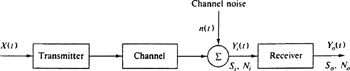
A schematic of a communication system is shown in Fig. 8-1. It is assumed that the input of the transmitter is modeled by the random process X( t). the channel introduces no distortion other than additive random noise, and the receiver is a linear system. At the receiver input, we have a signal mixed with noise. The signal and the noise power at the receiver input are S i and N i, respectively. Since the receiver is linear, the receiver output Y o( t) can be written as


where X o( t) and n o( t) are the signal and noise components at the receiver output, respectively.


Figure 8-1: A communication system model

We make two further assumptions about additive noise:

  1. The noise is zero-mean white gaussian with power spectral density S nn( ?) = ?/2.

  2. The noise is uncorrelated with X(

UNLIMITED FREE
ACCESS
TO THE WORLD'S BEST IDEAS

SUBMIT
Already a GlobalSpec user? Log in.

This is embarrasing...

An error occurred while processing the form. Please try again in a few minutes.

Customize Your GlobalSpec Experience

Category: Noise Meters
Finish!
Privacy Policy

This is embarrasing...

An error occurred while processing the form. Please try again in a few minutes.