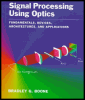
Signal Processing Using Optics: Fundamentals, Devices, Architectures, and Applications
The historical roots of optical processing extend as far back as 1859 when Foucault first developed the knife-edge test for lenses whereby direct image light is removed and scattered or diffracted light is kept. Subsequently, Abbe recognized in 1873 the importance of diffraction in coherent image formation, particularly for the case of microscopy. It was not until 1906 that Porter demonstrated Abbe's theory experimentally. Following this, in 1935 Zernike developed the concept of phase contrast microscopy, for which he later received the Nobel prize. In 1946 Duffieux described the application of the Fourier integral to optical problems.
By the 1950s, Elias and O'Neill connected the fields of optics and communication theory. Marechal, Tsujiuchi, Lohmann, and others expanded the applications of optical processing by addressing the image deblurring problem and the detection of two-dimensional signals in noise. In the 1960s, optical processing was applied to synthetic aperture radar. The development of the holographic matched spatial filter by VanderLugt and the computer-generated spatial filter by Lohmann and Brown further expanded the applications into pattern recognition. Optical transforms were also being applied to diffraction pattern sampling. Important work has also been carried out by Casasent, Psaltis, and many others using acousto-optics for correlation, spectrum analysis and radar signal processing using both time and space integrating architectures. More recently, optical computing has been extensively addressed, including discrete optical processors such as matrix vector and matrix matrix multipliers and processors utilizing serial, parallel, and systolic array concepts. Numerical processing, as well as nonlinear (Boolean logic)...