Signal Processing Using Optics: Fundamentals, Devices, Architectures, and Applications
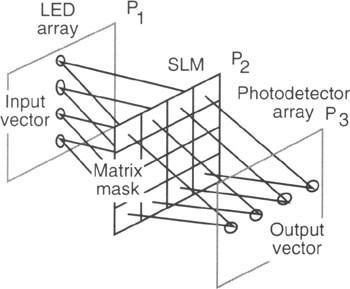
Before proceeding to address the classification function in pattern recognition, it is important to understand the operation of a fundamental optical processor architecture that performs vector matrix multiplication. The optical matrix-vector multiplier is an important architecture in connection with neural network as well as linear algebraic processing. The basic architecture is shown in Fig. 12.17. This particular architecture looks rather simple because the anamorphic optics required are not shown in order to simplify understanding the matrix-vector multiplication operation. Light from the LED sources is spread horizontally either by cylindrical lenses, optical fibers, or planar light guides to illuminate the 2-D mask or SLM representing matrix H. Light leaving plane P 1 is the vector f, which, if looked at as a continuous operation, can represent the function f( x). Light leaving plane P 2 is the product of f( x) and the impulse function h( x ?, y ?) or equivalently Hf, where H is the matrix version of h( x ?, y ?). This light is focused (spatially integrated) in x and imaged in y onto P 3 to yield g( y ?), which is equivalent to the discrete vector g. Hence g = Hf.
A more detailed account of the optics is shown in Fig. 12.18. Here the intensity of light emitted by the...