Signal Processing Using Optics: Fundamentals, Devices, Architectures, and Applications
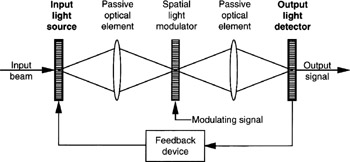
Optical signal processing would not be practical without electro-optical devices that interface between the optical architecture and the outside world. Ultimately, electro-optical devices are necessary for converting optical signals into electrical signals or vice versa. The "outside" world consists of (a) incoming optical radiation detected by appropriate sensors, (b) outgoing electrical or optical signals to enable command, control, communication, computation, or display, and (c) intermediate (optical or electrical) input signals for modulating the light distributed within the optical architecture. In the block diagram for the basic optical processor shown in Fig. 7.1, we are looking at the input and output devices, as highlighted below.
The input light sources we will consider for optical signal processing include the light emitting diode (LED) and laser diodes (both single elements, linear and matrix arrays). The output light detectors we will cover include single photodiodes, linear self-scanned arrays, and two-dimensional focal plane arrays (FPAs). Their principles of operation and their configurations will be given in some detail, and some general requirements on these devices for optical signal processing will also be summarized.
Lasers need an active medium in order to amplify light. Amplification is achieved inside a suitable Fabry Perot cavity via feedback, in which case the laser amplifier is also an oscillator in much the same way that an electronic amplifier achieves oscillation by feedback. Under these conditions a laser beam is produced in a so-called...