Signal Processing Using Optics: Fundamentals, Devices, Architectures, and Applications
In this chapter we will address the concept of correlation from a filtering perspective. In the previous chapter we considered it in the context of its equivalency to spectrum analysis, a connection established by the Wiener Khintchine theorem. As we will see, viewing correlation from a filtering perspective is also a productive approach since it leads eventually to other types of filtering and to feature extraction for pattern recognition. We will set the stage by reviewing the classic VanderLugt filter and then go on to consider improvements on the basic matched filter that improve its performance and make it less susceptible to distortions of the input image. Finally, we will consider a novel alternative to standard (Cartesian) correlation, known as angular correlation.
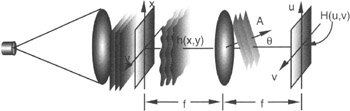
A historically important optical processing architecture involved with correlation is the VanderLugt filter. This is a matched filter created by a holographic method in which a reference image, consisting of a uniform plane wave of amplitude A and oblique incidence ?, is added to the Fourier transform of an input function h( x, y) at the output plane of a simple Fourier transform architecture as shown in Fig. 10.1. The result is
where ( u, v) = ( x 2/ ? F, y 2/ ? F), ? = (2 ? sin ?)/ ?, and H ( u, v) is...