The Six Sigma Way, How GE, Motorola, and Other Top Companies Are Honing Their Performance

An implementation blueprint for
Six Sigma.
 TABLE OF CONTENTS
 This is the chapter in which the Six Sigma engine really gets revved up. As we take you through the process improvement steps, both here and in the next chapter, the goal is to help you match or exceed the gains described back in Chapter 1. (see Figure 15.1).
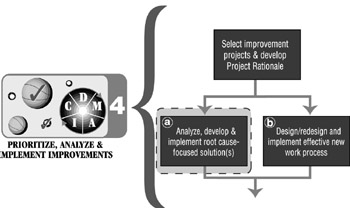
Our plan, mentioned earlier, is to illustrate the paths that go through Define, Measure, Analyze, and Improve by telling you a story, one that reveals how a typical team tends to work through a typical project. We ll mix the story with fascinating interludes in which we explain actions and tools. Of course, no team or project is really typical ; each is unique and poses special challenges. Still, an example will give you a better feel for the work that needs to be done and for how to do it well.
By the way, you may have noticed that we ve left off the C in DMAIC. Control is the end of DMAIC, but really the beginning of the sustained improvement and integration of the Six Sigma system. So, we ll tie Control tools and concepts into our discussion of Step 5 in Chapter 17: Expanding and Integrating the Six Sigma System.
Many of the basics of DMAIC (for example, the elements of a Project Charter) we ll deal with in this first chapter, while we ll focus on variations for design/redesign projects in Chapter 16. If you expect to be involved...