Small Signal Amplifier Design: A Collection from Applied Microwave & Wireless
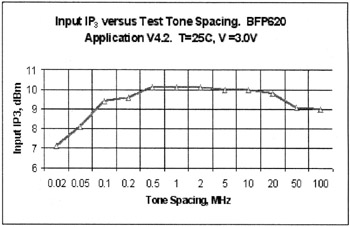
The reader may wonder what happens to third-order product distortion levels as the two input test tones are separated in frequency. A BFP620 V4.2 Applications Board was tested for input IP 3 over a range of test tone spacing, from 20 kHz to 100 MHz. In each case the midpoint frequency ( f 1+ f 2)/2 was 1960 MHz. Results are tabulated in Table 2 and plotted in Figure 5.
| f 1 (MHz) | f 2 (MHz) | ? f | IIP 3 (dBm) |
|---|---|---|---|
| 1959.990 | 1960.010 | 20 kHz | +7.1 |
| 1959.975 | 1960.025 | 50 kHz | +8.1 |
| 1959.950 | 1960.050 | 100 kHz | +9.4 |
| 1959.900 | 1960.100 | 200 kHz | +9.6 |
| 1959.750 | 1960.250 | 500 kHz | +10.1 |
| 1959.500 | 1960.500 | 1 MHz | +10.1 |
| 1959.000 | 1961.000 | 2 MHz | +10.1 |
| 1957.500 | 1962.500 | 5MHz | +10.0 |
| 1955.000 | 1965.000 | 10MHz | +10.0 |
| 1950.000 | 1970.000 | 20 MHz | +9.8 |
| 1935.000 | 1985.000 | 50 MHz | +9.1 |
| 1910.000 | 2010.000 | 100 MHz | +9.0 |
One limiting factor at close tone spacing is the available charge storage (for example, value of C3), or how good of a low frequency ground one has across the base-emitter junction (and also, to a lesser degree, at the collector). At wider tone spacing, the product ( f 2 ? f 1) rises in frequency. The impedance...