Small Signal Amplifier Design: A Collection from Applied Microwave & Wireless
RF/MW Amplifier Design

This article navigates through different gain and amplifier definitions to a straightforward design approach

By Les Besser

Overview

From APPLIED MICROWAVE & WIRELESS, VOL. 7, NO. 4, FALL 1995

Modern DAE techniques combined with component modeling and sound engineering judgment have changed linear RF amplifier design from an art to a science. When reliable S-parameters are available for the active device the initial RF design procedure is reduced to one of three procedures based on the transducer power gain, available power gain, or operating power gain definitions. The first of these techniques is outlined below; the other two will be discussed in a future article.

Transducer Gain Approach

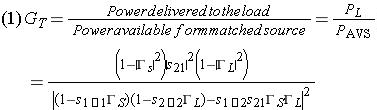
Of the many existing gain definitions the transducer power gain [1] of a two-port network (shown in Figure 1) is defined as


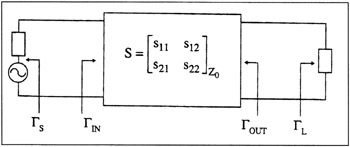
Figure 1: Generalized block diagram of a two-port device connected to arbitrary source and load terminations. The two-port device is characterized by its basic Z 0-based S-parameters.

Since the components of this basic definition are difficult to interpret, generally one of two alternative forms is used:


where


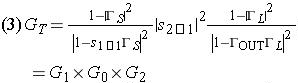
or


where


? IN and ? OUT represent the true input and output reflection coefficients of the two-port, having any arbitrary terminations ? S and ? L. Viewing these expressions gives a better interpretation of the composition of the overall gain since there are three distinct portions related to gain. These are:

  1. G 0: the basic 50-ohm gain, S 21

  2. G

UNLIMITED FREE
ACCESS
TO THE WORLD'S BEST IDEAS

SUBMIT
Already a GlobalSpec user? Log in.

This is embarrasing...

An error occurred while processing the form. Please try again in a few minutes.

Customize Your GlobalSpec Experience

Category: Logarithmic Amplifier Chips
Finish!
Privacy Policy

This is embarrasing...

An error occurred while processing the form. Please try again in a few minutes.