Small Signal Microwave Amplifier Design

6.4: Conjugate Matching Circuits

6.4 Conjugate Matching Circuits

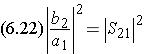
So far we have shown how to interpret the data sheets and find the regions of input and output reflection coefficient to design a stable amplifier. Now we can find an analytic way to design the input- and output-matching circuits of an amplifier. If the center of the Smith chart is stable, we can simply connect the transistor with 50 ohm transmission lines. The power gain of the circuit will be equal to


However, this will probably not be the largest gain that a transistor could have provided the circuit is optimized. Given the cost of microwave transistors, we want to obtain as much gain as possible. Thus, the transistor has be matched. Matching will transform the input and output impedance of the device to 50 ohms. The derivation of the stability circles has shown that the input match generally affects the output impedance of the device and vice versa. If we know what load or source impedance is connected to the device, the other matching circuit can be created. However, the maximum possible gain is obtained when both matching circuits are designed to achieve a simultaneous match of both input and output under the condition of maximum gain.

Equation 6.1 gives the input reflection coefficient of a two-port when Port 2 is terminated in an impedance with a reflection coefficient of ? L. Equation 6.6 shows the output reflection coefficient of a two-port with Port 1 terminated with ? s. We will force...

UNLIMITED FREE
ACCESS
TO THE WORLD'S BEST IDEAS

SUBMIT
Already a GlobalSpec user? Log in.

This is embarrasing...

An error occurred while processing the form. Please try again in a few minutes.

Customize Your GlobalSpec Experience

Category: Impedance Matching Networks
Finish!
Privacy Policy

This is embarrasing...

An error occurred while processing the form. Please try again in a few minutes.