Small Signal Microwave Amplifier Design

6.6: Constant Gain Circles

6.6 Constant Gain Circles

We have shown how to calculate the simultaneous conjugate match for a transistor that is unconditionally stable. We can achieve the maximum transducer power gain by matching the input and output of the transistor with circuits that create these reflection coefficients. When the transistor is potentially unstable, there is no safe conjugate matching point. In this case, the gain of the amplifier must be chosen so that it is less than or equal to the maximum stable gain. A systematic method of designing amplifiers with a predictable gain has to be developed. In the case of a potentially unstable transistor, one port must be purposely mismatched because a stable conjugate match does not exist.

First, we will consider the case in which the input is well-matched and the output is purposely mismatched to achieve a specific gain. The power gain in Equation 6.53 is independent of the source impedance and provides a practical method of mismatching the output of a transistor. We have control over the output mismatch that is seen by the transistor, or ? L. Contours of constant gain will be in the form of circles on the ? L plane. To find these circles, let G d be the desired gain. We invert Equation 6.53.


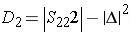
We can rearrange Equation 6.65


where


and B 2 and C 2 are given in Equations 6.32 and 6.33. Equation 6.65 can be written as


We solve for ? L,


which...

UNLIMITED FREE
ACCESS
TO THE WORLD'S BEST IDEAS

SUBMIT
Already a GlobalSpec user? Log in.

This is embarrasing...

An error occurred while processing the form. Please try again in a few minutes.

Customize Your GlobalSpec Experience

Category: Transistors
Finish!
Privacy Policy

This is embarrasing...

An error occurred while processing the form. Please try again in a few minutes.