Space-Time Coding: Theory and Practice

Chapter 2: Capacity of Multiple-Input Multiple-Output Channels

2.1 Transmission Model for Multiple-Input Multiple-Output Channels

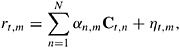
We consider a communication system, where N signals are transmitted from N transmitters simultaneously. For example, in a wireless communication system, at each time slot t, signals C t , n, n = 1, 2, , N are transmitted simultaneously from N transmit antennas. The signals are the inputs of a multiple-input multiple-output (MIMO) channel with M outputs. Each transmitted signal goes through the wireless channel to arrive at each of the M receivers. In a wireless communication system with M receive antennas, each output of the channel is a linear superposition of the faded versions of the inputs perturbed by noise. Each pair of transmit and receive antennas provides a signal path from the transmitter to the receiver. The coefficient ? n , m is the path gain from transmit antenna n to receive antenna m. Figure 2.1 depicts a baseband discrete-time model for a flat fading MIMO channel. Based on this model, the signal r t , m, which is received at time t at antenna m, is given by

(2.1)

where ? t , m is the noise sample of the receive antenna m at time t. Based on (2.1), a replica of the transmitted signal from each transmit antenna is added to the signal of each receive antenna. Although the faded versions of different signals are mixed at each...

UNLIMITED FREE
ACCESS
TO THE WORLD'S BEST IDEAS

SUBMIT
Already a GlobalSpec user? Log in.

This is embarrasing...

An error occurred while processing the form. Please try again in a few minutes.

Customize Your GlobalSpec Experience

Category: Antennas
Finish!
Privacy Policy

This is embarrasing...

An error occurred while processing the form. Please try again in a few minutes.