5.1 Pairwise Decoding
Full-rate orthogonal designs with complex elements in its transmission matrix are impossible for more than two transmit antennas as discussed in Chapter 4. The only example of a full-rate full-diversity complex space-time block code using orthogonal designs is the Alamouti scheme in Equation (4.21). Here we rewrite the generator matrix for the Alamouti code to emphasize the indeterminate variables x 1 and x 2 in the design:
| (5.1) | 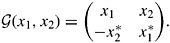
|
The main properties of an orthogonal design are simple separate decoding and full diversity. To design full-rate codes, we relax the simple separate decoding property. In this chapter, we consider codes for which decoding pairs of symbols independently is possible. We call this class of codes quasi-orthogonal space-time block codes (QOSTBCs) for reasons that we discuss later.
First, let us consider the following QOSTBC [67, 68]:
| (5.2) | 
|
where a matrix  * is the complex conjugate of , for example
| (5.3) | 
|
We denote the ith column of by  . For any indeterminate variables x 1, x 2, x 3, x 4, we have
| (5.4) | 
|
where < ,  > is the inner product of vectors and . Therefore, the subspace created by
  and
and  is orthogonal to the subspace created by
  and
and  . This is the rationale behind the name quasi-orthogonal for the code. The minimum rank of the difference matrix D( C i, C j) could be two. Therefore, following the definitions in Chapter 3,...


 TABLE OF CONTENTS