4.3 Maximum-Likelihood Decoding and Maximum Ratio Combining
Before discussing the design of codes for more than two transmit antennas, we study the structure of maximum-likelihood (ML) decoding. ML decoding amounts to finding the codeword ? that maximizes the density function in (3.4). Equivalently, ML decoding finds the codeword ? that solves the following minimization problem:
| (4.11) | 
|
Expanding the cost function in (4.11) and considering the fact that r H r is independent of the transmitted codeword and the choice of the codeword, we obtain
| (4.12) | 
|
Now, we show the relationship between the cost function for multiple receive antennas and that of one receive antenna. Let us define H m as the mth column of H. Representing H in terms of its columns results in
| (4.13) | 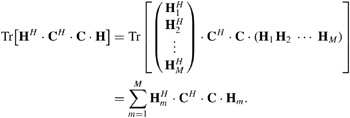
|
Similarly, defining r m as the mth column of r results in
| (4.14) | 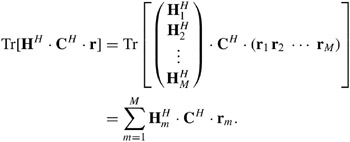
|
Therefore, using (4.13) and (4.14) in (4.12), we can calculate the cost function of the minimization problem in terms of the received signals and path gains for M receive antennas as follows:
| (4.15) | 
|
Note that if we only have the receive antenna m, M = 1, the corresponding minimization cost function is
| (4.16) | 
|
Therefore, we can write the cost function for only one receive antenna and add the correct summation in front of it to achieve the ML decoding formulas for the general case of M receive antennas. We call this maximum ratio combining (MRC). As...


 TABLE OF CONTENTS