Space-Time Coding: Theory and Practice

4.4: Real Orthogonal Designs

4.4 Real Orthogonal Designs

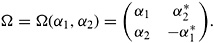
To design space-time codes that provide the properties of the Alamouti code for more than two transmit antennas, first we should understand why these codes behave in this way. To ease such an understanding, we rewrite (4.4) in a matrix form as follows:

(4.17)

where

(4.18)

Multiplying both sides of (4.17) by ? H gives

(4.19)

where is also a Gaussian noise. Equation (4.19) consists of two separate equations for decoding the two transmitted symbols. This separation is the main reason for the first property of simple ML decoding. The second property comes from the factor ? 1 2 + ? 2 2 in the right-hand side of (4.19). Although we have mathematically proved that the Alamouti code provides full diversity, an explanation based on the term ? 1 2 + ? 2 2 is also possible. When there is only one transmit antenna available, the power of the signal is affected by a factor of ? 2 due to the path gain. In a deep faded environment ? 2 is very small and the noise dominates the signal. On the other hand, (4.19) shows that using the Alamouti code ? 1 2 + ? 2 2 should be small for a noise dominated channel. To have a small ? 1 2 + ? 1 2,...

UNLIMITED FREE
ACCESS
TO THE WORLD'S BEST IDEAS

SUBMIT
Already a GlobalSpec user? Log in.

This is embarrasing...

An error occurred while processing the form. Please try again in a few minutes.

Customize Your GlobalSpec Experience

Category: Barcode Scanners
Finish!
Privacy Policy

This is embarrasing...

An error occurred while processing the form. Please try again in a few minutes.