Space-Time Coding: Theory and Practice

Similar to the case of real orthogonal designs, we generalize the theory of complex orthogonal designs to non-square matrices. We start with the definition of a generalized complex orthogonal design.
A generalized complex orthogonal design is a T N matrix
with entries that are linear combinations of the indeterminate variables x 1, x 2, , x K and their conjugates such that
| (4.76) | |
where I N is the N N identity matrix and ? is a constant.
Note that ? = 1 is possible by an appropriate normalization of
elements. Also, multiplying a generalized complex orthogonal design by a unitary matrix results in another generalized complex orthogonal design. In other words, if
is a generalized complex orthogonal design and U is unitary, that is U H U = I, then
? = U
is also a generalized complex orthogonal design. This can be shown using the fact that
. Similarly,
' =
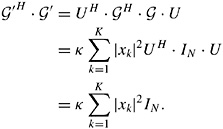
U is a generalized complex orthogonal design as well since
| (4.77) | |
A STBC for any complex constellation can be constructed using a generalized complex orthogonal design. The number of transmission antennas is N. We assume that transmission at the baseband employs a signal constellation with 2 b elements. At time slot 1, Kb bits arrive at the encoder and select constellation signals s 1,