Space-Time Coding: Theory and Practice

4.2: Alamouti Code

4.2 Alamouti Code

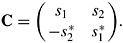
We start our discussion of space-time block coding with a simple example. Let us assume a system with N = 2 transmit antennas and one receive antenna, employing Alamouti code as in Figure 4.1 [4, 136]. To transmit b bits/cycle, we use a modulation scheme that maps every b bits to one symbol from a constellation with 2 b symbols. The constellation can be any real or complex constellation, for example PAM, PSK, QAM, and so on. First, the transmitter picks two symbols from the constellation using a block of 2 b bits. If s 1 and s 2 are the selected symbols for a block of 2 b bits, the transmitter sends s 1 from antenna one and s 2 from antenna two at time one. Then at time two, it transmits ? and from antennas one and two, respectively. Therefore, the transmitted codeword is

(4.1)

Fig. 4.1: Transmitter block diagram for Alamouti code.

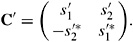
To check if the code provides full diversity, we need to calculate the rank of all possible difference matrices D( C, C ?) and show that it is equal to two for every C ? ? C. Let us consider a different pair of symbols ( , ) and the corresponding codeword

(4.2)

The difference matrix D( C, C ?) is given by

(4.3)

The determinant of the difference matrix is zero...

UNLIMITED FREE
ACCESS
TO THE WORLD'S BEST IDEAS

SUBMIT
Already a GlobalSpec user? Log in.

This is embarrasing...

An error occurred while processing the form. Please try again in a few minutes.

Customize Your GlobalSpec Experience

Category: Antennas
Finish!
Privacy Policy

This is embarrasing...

An error occurred while processing the form. Please try again in a few minutes.