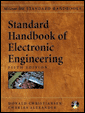
Standard Handbook of Electronic Engineering, Fifth Edition
Telecommunication systems and applications deal with the actual technology by which devices communicate with each other. This includes transmission systems, switching systems, local area networks (LANs), wide area networks (WANs), broadband systems, cellular and mobile communication systems, and wireless digital communications. It is interesting to note that in areas of the world where the infrastructure for wire-based communication systems does not exist, it seems that development of such systems will be skipped and they will go directly to wireless.
Future trends dictate that we must communicate more information much faster, much more reliably, and send more transmissions over the same system. We will continue to see wireless technology becoming the dominant communication system. A very good example is the increase in ways of wireless connection to the Internet such as cell phones and PDAs. Clearly, security will also be a dominant force in determining how we communicate. Such security will need to be achieved without degrading the communication process and without making communicating more difficult.
Chapter 17.5, Wireless Networks, deals with technologies that combine Internet access with cell phone communication, with picture and email transmission, and walkie-talkie communication. These technologies must allow us to communicate and use information seamlessly, across a wide variety of devices and platforms.
In Chap. 17.6, we look at...